Kawaii Mouse 3D Print Model: A Practical Addition to Your Creative Workflow
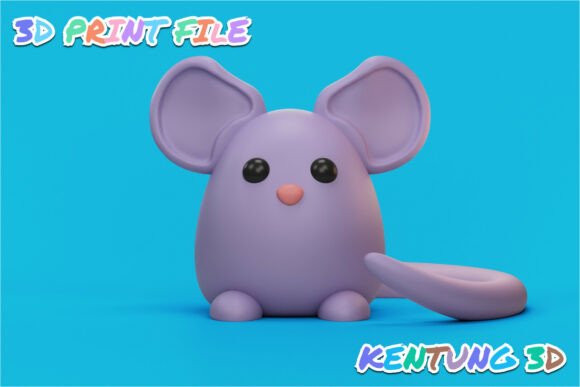
For 3D printing enthusiasts and creative professionals, the Kawaii Mouse 3D Print Model offers more than just a charming aesthetic. Designed in a soft kawaii style with oversized rounded ears, a minimalist body, and a curled tail, this STL model bridges the gap between functionality and visual appeal. Whether you're a hobbyist, a small business owner, or an educator integrating 3D printing into your curriculum, this model can be a versatile asset in your design and production process.
Understanding the Kawaii Mouse 3D Print Model
The Kawaii Mouse 3D Print Model is an STL file optimized for both FDM and resin printers. Its clean geometry makes it accessible for beginners while still offering a polished final product suitable for professional display or gifting. The design emphasizes soft curves, simplicity, and charm—key elements that make it ideal for use in environments where aesthetics and approachability matter, such as nurseries, workspaces, or collectible displays.
At its core, this model serves as a standalone printable asset but also functions as a modular component in larger creative or commercial workflows. Its compatibility with PLA and PLA resin ensures that it integrates smoothly into existing 3D printing setups without requiring specialized materials or advanced calibration.
Integrating the Kawaii Mouse into Your 3D Printing Workflow
Before printing, consider how the Kawaii Mouse fits into your broader project goals. If you're building a collection of printable decor items for resale or personal use, this model can act as a consistent visual theme or a complementary piece within a themed set. Because of its beginner-friendly nature, it’s a good candidate for batch printing or as a test print to check material consistency and printer calibration.
During the design phase, the model’s scalability allows for customization. You can resize it to fit specific display dimensions or combine it with other STL files to create composite scenes or interactive models. This flexibility supports iterative design workflows where rapid prototyping and user testing are part of the development cycle.
Post-Print Applications and Practical Uses
Once printed, the Kawaii Mouse can be used in multiple ways. For entrepreneurs and Etsy sellers, it makes a thoughtful handmade gift or a curated decor item that appeals to niche markets. Educators can incorporate it into classroom activities to demonstrate 3D modeling concepts or as a tangible reward for student engagement.
- Desk decor: A small printed mouse adds personality to workspaces without taking up much room.
- Nursery decoration: The soft, non-threatening design makes it a safe and appealing choice for children's rooms.
- Collectible display: For hobbyists building curated 3D-printed collections, this model adds a touch of whimsy and cohesion.
- Gift-giving: With minimal post-processing, it can be painted or finished to create a personalized, handcrafted gift.
Compatibility and Technical Considerations
The Kawaii Mouse STL model is compatible with most FDM and resin printers, making it a versatile option for a wide range of users. When preparing for print, ensure your slicer settings are adjusted for PLA or PLA resin, and verify that support structures are enabled to maintain the integrity of the mouse’s curved tail and rounded ears.
Because of its clean geometry, it typically requires minimal cleanup after printing. This contributes to efficiency in production workflows, especially when time or material conservation is a priority. However, for those looking to enhance the finish, light sanding and a primer coat can help achieve a smoother surface for painting or sealing.
Workflow Examples: How the Kawaii Mouse Fits Into Real-World Use
Consider a small business owner who sells custom 3D-printed home decor items online. The Kawaii Mouse can be integrated into their product line as a seasonal or year-round offering. The model’s simplicity allows for fast turnaround, and its recognizable design makes it a repeatable product that customers can easily identify and request again.
For educators, the model can be part of a lesson plan that introduces students to 3D printing fundamentals—file preparation, scaling, material selection, and post-processing. It also serves as a creative incentive, encouraging students to design their own kawaii-style models once they understand the basics.
Freelancers and content creators can use the Kawaii Mouse in unboxing videos, print demonstrations, or social media content focused on 3D printing tips and tricks. Its visual appeal makes it a strong candidate for tutorials or affiliate marketing content around 3D printing tools and materials.
Quality Control and Long-Term Use
When incorporating the Kawaii Mouse into a recurring workflow, consistency is key. Establish a standard print profile for this model to ensure uniform results across multiple prints. This is especially important for creators selling the item or using it in a professional context where visual consistency matters.
Over time, you may want to explore variations—printing in different colors, combining it with other STL models, or even modifying the original design for custom adaptations. Maintaining a digital and physical archive of your prints and settings helps streamline future use and supports long-term project continuity.
Final Thoughts on Practical Implementation
The Kawaii Mouse 3D Print Model isn't just a decorative item; it's a functional element in a broader creative or business process. Whether you're using it as a standalone print, part of a themed collection, or as a teaching tool, its design and technical specifications make it a reliable and adaptable resource. By understanding how it fits into your workflow—from planning and printing to post-processing and application—you can maximize its value and ensure it becomes a staple in your STL library.